

Hobby Model Shop HOBBYSTA   
  Top » Catalog » Plastic models » Plastic Aircraft Model Kits » Aircrafts 1:72 » Roden 012 My Account  |  Cart Contents  |  Checkout   
 
Use keywords to find the product you are looking for.
Advanced Search
Plastic models->
  Engines / machines
  Plastic Armor Model Kits->
  Plastic Aircraft Model Kits->
    Aircrafts - accessories 1:32
    Aircrafts - accessories 1:35
    Aircrafts - accessories 1:48
    Aircrafts - accessories 1:72
    Aircrafts 1:24
    Aircrafts 1:32
    Aircrafts 1:35
    Aircrafts 1:48
    Aircrafts 1:72
    Aircrafts 1:100
    Aircrafts 1:144
    Aircrafts 1:350
    Aircrafts - the others
    Passenger aircrafts
  Helicopters->
  Trucks
  Cars->
  Motorcycles / Bikes->
  Ships->
  Figures->
  Animals
  Gift sets
  Space ships & vehicles
  Models for diorama 1/35
  Castles & buildings
  Plastic Loco & Cars Model Kits
  Gun replicas
Wooden models->
Cardboard models->
Die Cast & Pre Built Models->
Battle games->
Star Wars models
Trains / Railway Models->
SIKU Models->
WIKING Models->
Metal & Die-cast models->
Remote control vehicles R/C->
Add ones->
Landscaping & ground mats->
Paints->
Glues & fillers
Tools & accessories->
Puzzle->
Literature->
Nowe produkty w sklepie
Queen Mary 2 Gift Set
€44.34
Shipping & Payments
Privacy Notice
Conditions of Use
Contact Us
Site Map
Zamienniki dla farb HUMBROL

PayPal

www.platnosci.pl

Visa MasterCard

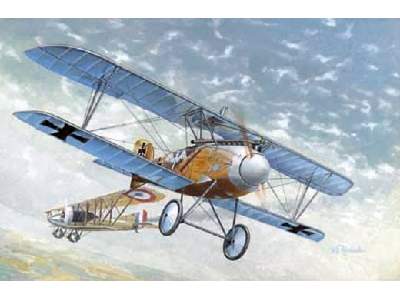
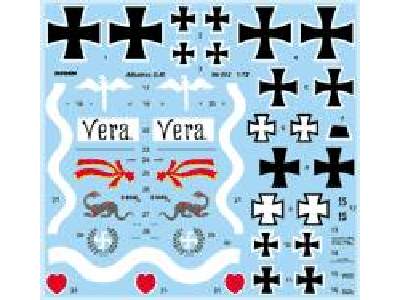
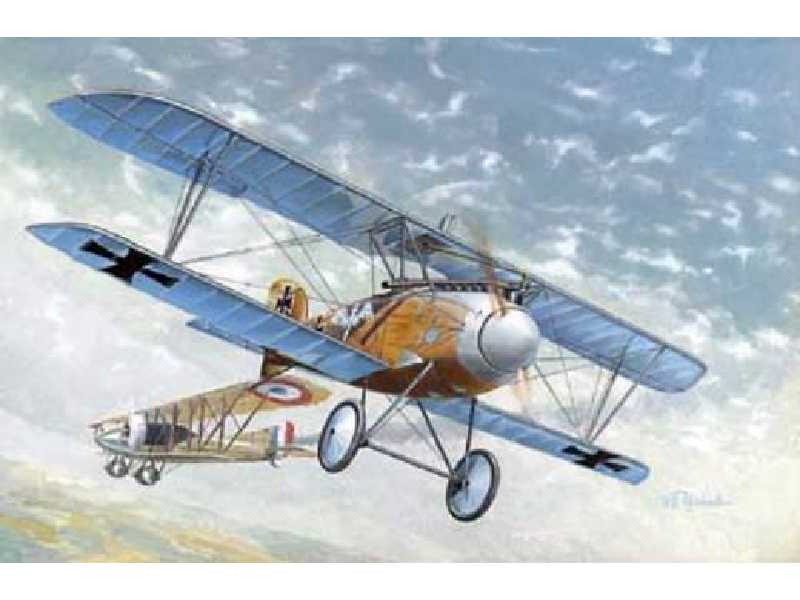
Albatros D.III
[Roden 012]
€5.23

Skala: 1/72

Unassembled plastic model kit.

Paints and Glue are not included with any kit unless stated otherwise!

The appearance of the Albatros D.III was closely influenced by the latest French designs, in particular Nieuport. Of course, Nieuport fighters were not true biplanes but "sesquiplanes" (ie. 1 ˝ wings). The lower wing was built around a single spar, and the chord of the lower wing was narrower in comparison with the upper wing. Robert Thelen and the Albatros designers completely rebuilt the wing cellule; all others elements of the Albatros D.II (fuselage, tail unit, undercarriage) were still in place. Only the interplane struts received a new configuration: parallel struts were replaced by V-struts.
Some aspects of performance, like maneuverability and climb, increased, but speed was unchanged. The power of the Mercedes D.IIIa engine was now rated at 160 h.p., but this was not enough. Teeves & Braun replaced Windhoff side radiators, retained on many D.IIs, with an installation on the wing.
The first mass-production aircraft reached the Front in December 1916, and were greeted with enthusiasm by many pilots. But very soon many of the aircraft crashed: the lower wing had a tendency to collapse in excessive maneuvers. Even Manfred von Richthofen almost fell victim to this fault on January 24th 1917, but he was fortunate enough to effect a hurried forced landing. He changed his Albatros for a Halberstadt D.II, but one month later he again returned to the cockpit of the Albatros. Despite the problem with the lower wing, the Albatros D.III was still the best German fighter in the first half of 1917 and superior to any Allied fighter. "Bloody April" of 1917, when Great Britain lost 151 aircraft on Western Front (Germany lost 30), led the Allies to seek an adequate answer to the Albatros D.III.
Production of the Albatros D.III increased from month to month: in March 1917 137 were in service at the Front, 327 in May, and 446 in November of the same year. The parent plant of Albatros Flugzeugwerke, situated in Johannistahl, built 500 fighters of this type, and the branch factory OAW in Schneidemuhl built an additional 840 aircraft. The OAW fighter was distinguished from the original D.III by the rounded edge of the rudder. Even when the more modern Albatros D.V appeared, production of the D.III was not stopped; many D.IIIs were still in service until the last days of the war.
The Albatros D.III did not only serve on the Western Front. Many fighters were sent to the Italian Front and Palestine. The warmer climate of Palestine required better engine cooling, and as a result, one more radiator was installed on the wing. But the Albatros D.III was not as successful in this theater as in France.
The first half of 1917 was the "star time" for the Albatros D.III. The introduction of the British S.E.5 and French Spad S.7 immediately made it obsolete. But at the end of 1918, when the Fokker D.VII dominated in the sky, many Albatros D.IIIs were still defending the air space of Germany.

Performances
Wingspan upper9,5 m
Length7,33 m
Take off weight908 kg
Time of 1000 m altitude reaching2min 30sec
Speed, max165 km/h
Enduranceabout 2 hours
Engine1x160 hp Mercedes D.III
Machine guns2xLMG 08/15 Spandau

This product was added to our catalog on Saturday 08 March, 2008.
Last available: Monday 23 January, 2012.
Reviews Sold Out
Customers who bought this product also purchased
Breguet Bre-14B French service
Pfalz D.IIIa fighter
Pfalz D.III Fighter
Pfalz D.III Fighter
Paint Gloss Black (gloss)
Paint Polished aluminium
F-117A "Stealth"
F-117A "Stealth"
Do koszyka
0 items
Polski English
Roden
Other products
Informowanie o produktach
NotificationsNotify me of updates to Albatros D.III
 
Tell someone you know about this product.
Do recenzji
Write ReviewWrite a review on this product!